
…T2 tankers were ships that were built and used on a large scale during the Second World War.
The record to build a T2-tanker was 33 days.
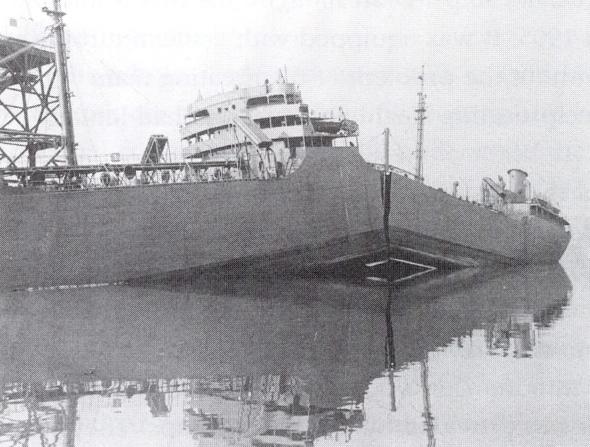
Bad construction.
Building this type of ship brought numerous problems with it.
Design flaws, poor welding, haste, use of unsound materials and mostly unskilled personnel were usually the cause.
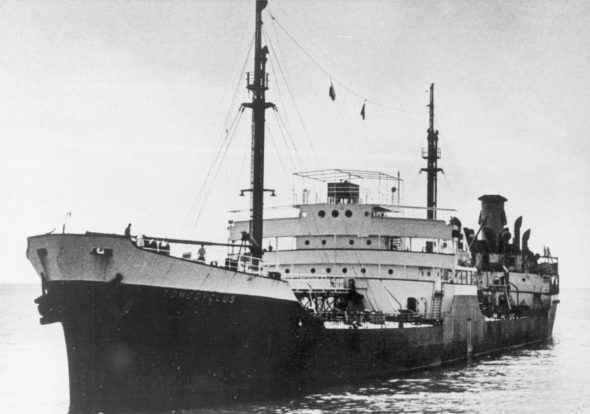
The British Shell tanker ‘Tomocyclus’.
The demand for ships was high after the war.
In order for countries to put their merchant fleet back in order, a lot of sailing war material was given on loan or sold under certain rules.
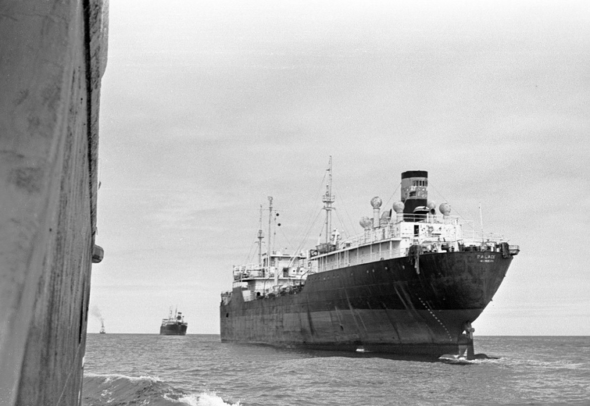
The ‘Gelderland’ with two T2-tankers for scrapping in tow.
Around the seventies there was a real exodus of ships for scrapping, the big cleanup had begun.
They were meekly towed to places where they could still be useful.
The ships in the ‘mothball fleet’ now had only scrap metal value.
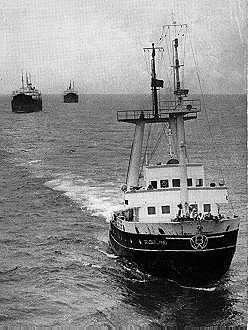
Seen from the other side.
Sometimes you came across an ‘oldie’ like that, at sea or in the locks of IJmuiden.
Some well maintained, others worn out and sailed to pieces.
The Scaramanga yard, near the port of Piraeus, was full of them.
The nostalgia will not alter the fact that it was hard work on these ships.
Especially in the engine room.
For a bit of ventilation in the accommodations, you had to provosorily make a wind chute and stick that out through the porthole.
Still, a number of ships escaped that fate and faithfully made many sea miles after wartime.
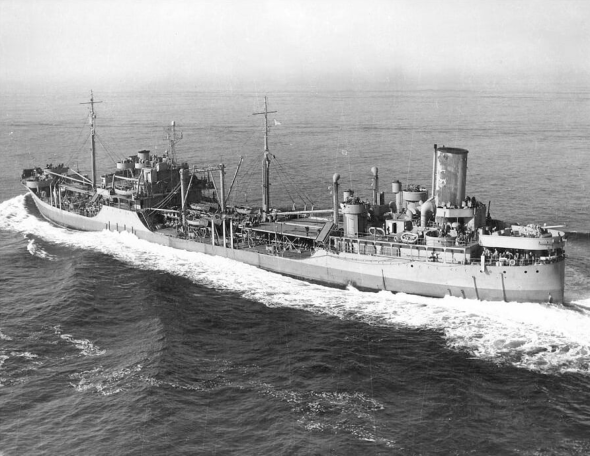
A T2 tanker in wartime.
As with T2 tankers, Liberty’s or whatever all those types were called, they disappeared from Neptune waters after the war.
Mothball Fleet
After the war ended they had a surplus of ships and other equipment.
Much was then laid up for perhaps further use.
Developments in sea transport meant that the laid-up ships became redundant and were ripe for towing to a scrapyard.
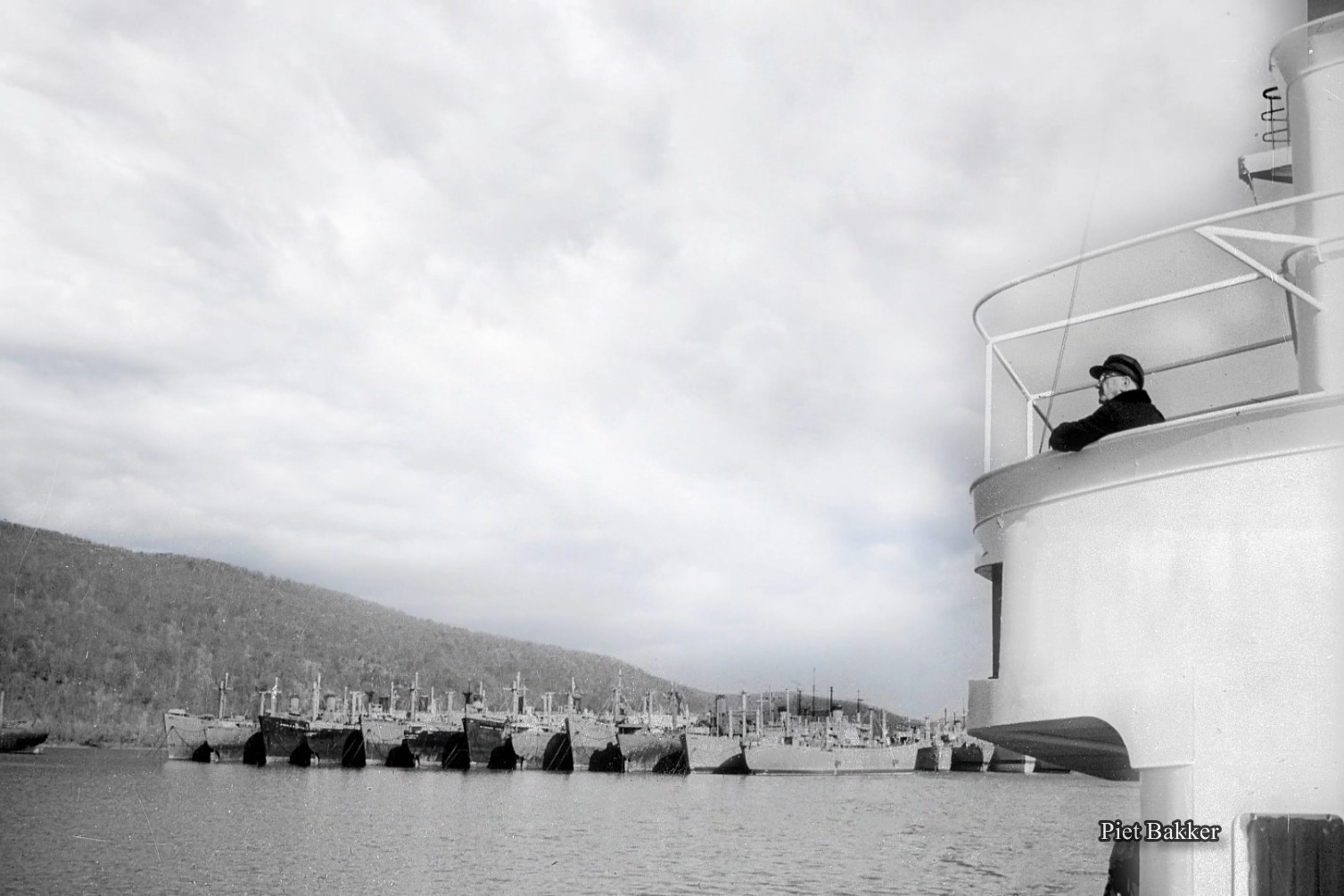
A mothball-fleet and the wing of the ‘Jacob van Heemskerck’.
Sometimes a section of a T2 tanker was used.
In Marsa el Brega, one such composite vessel, a Greek, once arrived.
The bow of a modern tanker attached to the stern of a T2 tanker in which the propulsion was located.
There was a wide variation in the width!
Everything was welded together with a slice of cake as the bridge which came from another tanker.
It was a strange monstrosity, but it floated!
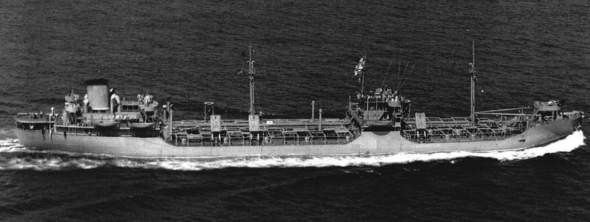
SS ‘Hat Creek’.
Nostalgia
You keep looking for a good image of a T2 tanker.
Then you find one with a piece of nostalgia in the background.
On the chimney it says ESSO, my father used to work there.
The T2 tanker was the ‘Caltex Utrecht’, she sailed under the national flag.
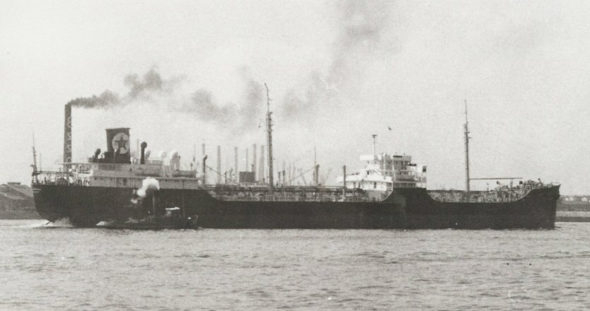
Caltex Utrecht’.
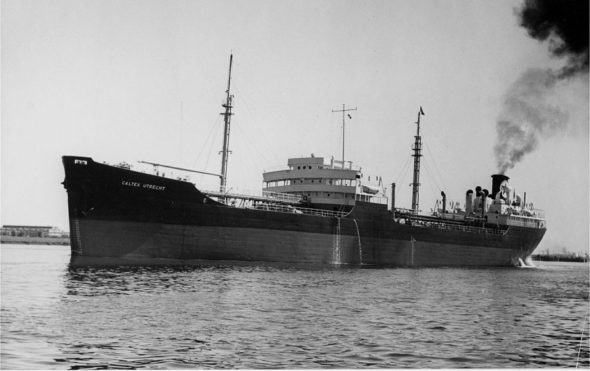
Launched as a T2-SE-A1 ‘Blue Licks’ 1945 – 1967.
Global data of a T2-tanker:
length: 159.6 mtr
width: 20,7 mtr
draught: 9.1 mtr
load capacity: 16,613 dwt
propulsion: turbine/electric, single screw 6000 apk
speed: 14,5 knp (27 km/h)
range: 12,600 miles (23,300 km)
capacity: 10,200 tonnes (141,150 barrels)
crew: approx. 53
Fourteen of these tankers have sailed for the Dutch merchant marine.
(For more information see the Dutch site: T2-tankers.)


Leave a Reply